Annual Spiritual Impact Event
Annual Spiritual Impact Event: A Complete Guide for Churches Seeking Renewal.
In an era when churches face declining attendance, spiritual fatigue, leadership burnout, and cultural pressure, many congregations are asking a crucial question: How do we renew spiritual vitality in a sustainable way?
The Annual Spiritual Impact Event offers a clear, biblical, and repeatable answer. Rather than relying on sporadic revivals or one-time programs, an Annual Spiritual Impact Event provides a strategic, once-a-year rhythm designed to realign a church’s heart, mission, leadership, and congregation around spiritual renewal and purposeful action. This guide serves as the definitive pillar resource for understanding, planning, and implementing an Annual Spiritual Impact Event in churches of any size.
What Is an Annual Spiritual Impact Event?
An Annual Spiritual Impact Event is a planned, prayer-centered, mission-focused gathering or series of gatherings that serves as the spiritual anchor of a church’s calendar year.
Unlike traditional revivals that often emphasize emotional intensity without long-term structure, an Annual Spiritual Impact Event is:
Intentional – planned ome year in advance.
Biblical – rooted in Scripture, prayer, and repentance.
Strategic – aligned with vision, discipleship, and outreach.
Repeatable – held every year to create momentum.
Transformational – designed to change lives, not just schedules.
Its purpose is not entertainment, novelty, or spectacle—but spiritual alignment and lasting impact.
Why Churches Need an Annual Spiritual Impact Event.
Many churches operate on autopilot. Programs continue, sermons are preached, meetings are held—but spiritual passion quietly erodes. An Annual Spiritual Impact Event interrupts that drift.
Key reasons churches need this event:
1. Spiritual Renewal.
Congregations need regular seasons of reflection, repentance, prayer, and recommitment.
2. Vision Realignment.Over time, churches drift from their mission. This event refocuses hearts on why the church exists.
3. Leadership Unity.
Pastors, staff, and lay leaders need a shared spiritual moment that resets priorities.
4. Discipleship Momentum.
An Annual Spiritual Impact Event ignites spiritual practices that continue long after the event ends.
5. Cultural Resistance.
In a distracted, digital, and fragmented world, intentional spiritual formation is essential.
Churches that neglect renewal eventually rely on activity instead of anointing.
Annual Spiritual Impact Event vs. Traditional Revival.
Traditional Revival Annual Spiritual Impact Event
Often reactive. Proactively planned.
Emotion-driven. Spirit-led and strategic.
Short-term focus. Long-term transformation.
One-time emphasis. Annual rhythm.
Attendance-centered. Discipleship-centered.
An Annual Spiritual Impact Event doesn’t replace revival—it redeems it, giving renewal a structure that lasts.
Core Biblical Foundations.
Throughout Scripture, God’s people regularly paused for corporate spiritual realignment:
Seasons of fasting and prayer.
Covenant renewal gatherings.
National calls to repentance.
Leadership commissioning moments.
Festivals that reminded people who they were.
An Annual Spiritual Impact Event stands in this biblical tradition—creating sacred time for spiritual recalibration.
Who Is This Event For?
An Annual Spiritual Impact Event works for:
Small churches needing unity and clarity.
Mid-size churches seeking renewed momentum.
Large churches desiring spiritual depth beyond programs
New churches establishing healthy rhythms.
Established churches fighting stagnation.
Size does not determine impact—intentionality does.
Core Components of an Effective Annual Spiritual Impact Event.
Every successful Annual Spiritual Impact Event includes these essential elements:
1. Prayer Preparation.
Months of prayer precede the event. Spiritual impact begins before planning meetings.
2. Clear Spiritual Theme.
Themes focus on renewal, surrender, mission, discipleship, or obedience.
3. Scripture-Centered Teaching.
Teaching emphasizes biblical truth applied to real life and church culture.
4. Leadership Engagement.
Leaders participate visibly—not just administratively.
5. Congregational Involvement.
The event is not something done to the church, but with the church.
6. Follow-Up Pathways.
Spiritual growth continues through small groups, discipleship, and service opportunities.
When Should an Annual Spiritual Impact Event Be Held?
Timing is critical in the 21st century. This event focuses on a three day weekend, Friday night through Sunday morning. It is best scheduled on the last weekend of February or the first weekend of March. Avoid all local school athletic schedules. Avoid Superbowl Sunday. Consistency matters! Holding it annually trains the congregation to expect renewal.
Planning Timeline (12-Month Model).
12 Months Out.
Prayer focus begins.
Leadership alignment.
Theme discernment.
6 Months Out.
Teaching structure developed.
Speaker or facilitator confirmed.
Communication planning.
3 Months Out.
Congregational prayer emphasis.
Volunteer coordination.
Promotional clarity.
Event Month.
Execution with flexibility for the Spirit.
Emphasis on participation, not performance.
Post-Event (Next 90 Days).
Small groups launch.
Discipleship pathways activated.
Leadership evaluation.
Measuring Spiritual Impact (Beyond Attendance).
Spiritual fruit cannot always be quantified—but signs of impact include:
Increased prayer participation.
Renewed volunteer engagement.
Reconciliation and healing.
Clearer vision alignment.
Growth in discipleship commitments.
Renewed hunger for Scripture.
The question is not “How many came?” but “Who is being transformed?”
Common Mistakes to Avoid.
Treating the event like a conference instead of a spiritual encounter.
Over programming without prayer.
Neglecting follow-up discipleship.
Making it pastor-centered instead of church-centered.
Measuring success by excitement instead of obedience.
An Annual Spiritual Impact Event is not about hype—it is about holiness.
How the Book Annual Spiritual Impact Event Helps Churches.
The book Annual Spiritual Impact Event provides churches with:
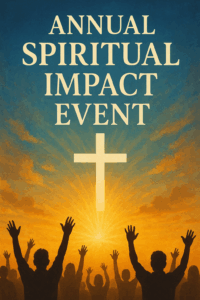 A complete theological foundation.
Practical planning frameworks.
Leadership models.
Annual scheduling templates.
Discipleship follow-through strategies.
Real-world ministry insights.
It equips pastors, boards, and ministry teams to institutionalize renewal without institutionalizing the Spirit.
Why This Model Works Long-Term.
Churches that establish an Annual Spiritual Impact Event experience:
Less burnout.
Clearer vision.
Stronger leadership culture.
Deeper discipleship.
Greater spiritual expectancy.
When renewal becomes rhythmic, it becomes sustainable.
Final Encouragement.
Every church—no matter its size, location, or history—needs intentional seasons of spiritual renewal. An Annual Spiritual Impact Event provides a biblical, practical, and powerful way to refocus hearts on God’s purpose year after year.